


In the message of Christ there is one doctrine – that of Divine Providence – which embraces the whole of existence and at the same time concerns each person individually. According to this, anything that happens in the world is directed by the love, wisdom, and might of the Father for the benefit of the faithful.
The word Providence is often used rather loosely with no more than a vague or ill-defined meaning. Therefore in the first place we must define its meaning. Christ has frequently spoken of Providence. He did so with special force and detail in the course of that body of teaching which is called the Sermon on the Mount (Matthew 6:25-34). There He admonishes His listeners to take no thought for food or raiment, for the heavenly Father knows what man needs. To worry about these things is to act like the heathen. The believer should have confidence that he will not lack anything.
The listener is not being asked to put his faith in a fairy tale. He is not being told that he can discard all labor and foresight and live heedlessly from day to day because miraculous powers will look after him.
What is being said takes into account life as it really is and overlooks none of its hardships. Providence is not therefore a flight of fancy but sober reality. On the other hand it is not something that should be taken for granted from a worldly point of view. For instance, Providence does not mean that everything follows an inviolable order in which one must find a place or that the self-confident can master life more easily than those who are anxious or distrustful. It means something quite out of this world – that the living God is personally concerned with every single human being and ready to look after him. Thus Providence is neither a fairy tale nor, on the other hand, a piece of natural philosophy; not a code of life but simply a revelation by the grace of God.
Providence calls us to seek first the kingdom of God
In the Sermon on the Mount, as an example of how God feels about the needs of His creatures, Christ points to the birds who neither sow nor reap and to the lilies of the field who neither toil nor spin. This, at first sight, would appear just a pious idyll, but then comes the sentence which shows how serious it all is:
“Seek therefore first the kingdom of God, and His justice, and all these things shall be added unto you.”
Matthew 6:33
This sentence expresses what Christ means the proper attitude of God’s children to be: that man should firstseek the kingdom of God and His justice, that is, before and more than anything else. Man’s concern about the kingdom should be the center and mainspring of his life.
This is something very great and very difficult which fundamentally assumes that conversion or repentance which the Lord demands at the beginning of His message: “Do penance, for the kingdom of heaven is at hand” (Matthew 4:17).
Whoever thinks in this way is in agreement with God because he wishes that His kingdom and holy justice should come. Out of this understanding, Christ says, the course of events will fall into place around the faithful. Thus things, people, conditions, and destinies do not happen to us fortuitously but form a wholeness: the world of the individual. This wholeness differs according to the mentality and character of the person and, we may add, according to how far we allow for God’s sway in our lives.
The course of events is not predetermined like the working of a machine but rather is infinitely fluid, full of potentialities, and ready to submit to the will which is able to govern it. A deeper insight into man shows to what an extent the inmost attitude, often quite unconsciously, determines the course of our destiny. Therefore, for the individual who is prepared to submit to the will of God, this destiny will be quite different from that of the man who acts according to his own obstinate and at the same time uncertain will.
Moreover – and this is the decisive factor – the world is in the hands of God. The laws of nature are His servants. Out of the hearts of men He orders the course of events, in each one of the individual worlds as well as in the world as a whole. Whenever, therefore, the human heart shares with Him the holy care for the kingdom, the word fulfills itself according to which “to them that love God, all things work together unto good” (Romans 8:28). This does not mean that the man who has submitted to the will of God will be spared pain and sorrow, but it does mean that he will have what he needs and that everything that happens, including the misfortunes, serves the true end of his life.
The message of Providence demands something very great of man: that he should make the care for God’s kingdom the prime care of his life. It promises him something equally great: that the events which take place around him occur in a very special way and shape an existence which is determined by God’s care for his particular good.
Faith helps us understand Providence
This promise is not a fairy tale but reality. But it is not that reality which is actually before us – in other words, a reality of nature or history – but the reality which springs from God. But again, it is not a kind of mysterious reality outside nature and history, but right in their midst. It is not apprehended, like a fairy tale, with our imagination, nor, on the other hand, like things of immediate actuality, by natural observation and intellect.
Providence is apprehended through the eyes of faith. We hear of it through the word of God; and having staked our faith on this reality we find it actually does come into being. The world, such as it is, always seems to contradict the working of Providence and our hearts are quickly perplexed and discouraged, so we must always renew our faith. Slowly we begin to see the underlying pattern—for instance, the meaning of an event, of an encounter, of a success or a failure.
We sense behind the forces and necessities which otherwise govern events a new power and a new purpose. We feel that we are included in a holy design which comes from God.
This awareness may at times become very vivid and then again disappear. Often it will pervade our life merely as a feeling of quiet confidence. For the rest, it will be based on faith. The ultimate remains hidden and will be revealed only when, at the end of time, the kingdom of God is fulfilled. That which happens by Providence in the life of the individual is a part and an aspect of the coming world, in which, on a new earth and under a new heaven, the new man will live (Revelation 21:1). This world is already in process of emerging around those who open themselves to Providence, but it will be revealed only at the end of all things.
Contemplative prayer reveals the workings of Providence
In the world of the New Testament, Christian consciousness is steeped in the idea of Divine Providence, and with unsophisticated people whose lives are—or appear to be—governed by forces entirely beyond their control, this is still to a certain extent true today.
But, generally speaking, faith in Divine Providence does not now play an important part in Christian life. There are many causes for this which we cannot discuss here, but undoubtedly a more active faith in Providence should be an essential factor in the Christian life and, for that matter, also in Christian prayer.
Above all we should reflect on Divine Providence in order to understand and to absorb its meaning. We have talked about contemplation—one of its most fruitful subjects should be the message of Divine Providence, especially the words of our Lord on this subject, not only in the great passage in the Sermon on the Mount, but also His other utterances, teachings, and parables throughout the Gospels. We should also contemplate Christ’s own relationship to the will of the Father, that experience which He called His “hour,” (John 2:4; 7:30; 12:27), the way in which He experienced and underwent events, and the temper of His mind.
Then we must learn to understand the world and history in the context of Providence, overcoming the concept of an impersonal, mechanistic world order which has been forced upon us by science and is reflected in the attitude of the masses. This conception is false. By it, the world is taken out of the hands of God, but it does not thereby acquire an independent scientific or cultural status, but passes into the hands of God’s enemy. Thus the task is, by contemplation, to draw the world back into its true focus. The doctrine of Providence runs counter to the general trend of opinion. Here we must hold our ground. It is the battle of faith whose victory “overcomes the world” (John 16:33) – the old unregenerate world – and ushers in the new, eternal one.
Contemplation reveals what God demands of us in this moment
In the Sermon on the Mount there is the Lord’s Prayer. Its true meaning becomes clear only in the light of the doctrine of Providence. Not until we recognize that it is the living God who governs the destiny of the world and evaluate the meaning of our own individual existence under this aspect – and, even more, not until we also understand that the kingdom of God is entrusted to our care, weak and insufficient as we are – will we grasp the full import of the Lord’s Prayer.
We are not so much concerned here with the wider implications of Providence as with God’s governance as it is fulfilled from event to event in the life of the individual. Thus it is the task of contemplation to try to grasp the pattern of this life and the meaning of specific phases and situations in the light of Divine Providence.
This Providence does not unfold according to a fixed program but works through the facts and developments in our lives. The streams of general and personal existence flow together. Irresistibly conditions change and causes act, phenomena appear and disappear. At the same time something strange happens: the flow of events assumes an order around us and seems to pose a challenge. “Look,” it appears to say, “understand, act, do what is required at this moment for the coming of the kingdom, for if you fail to do it now, it can never be done again.” This is the situation, “the hour,” my hour, in which the will of God becomes concrete for me. This is the situation which I make part of my contemplation and try to understand. “What does it mean in the sight of God? What is my part in it?”
God demands something of me which belongs to “His kingdom and its righteousness.” (Matthew 6:33; Luke 12:31) He demands it of me and He demands it now. He will enable me to understand what this is. “How?” we might ask. We obtain this understanding not through mystical experience or illumination but through the truth inherent in the situation. The truth of this situation will be revealed as soon as we cease to regard it from the point of view of the world or our own self-will, but take it to God, ready to submit it to His judgment.
The uncertainty about what to do may spring from various sources. For instance, the situation may not as yet present a clear challenge and one cannot therefore know what is the right course: in this case one should not act but wait. Or vision and judgment may be lacking, in which case one should do one’s best according to one’s lights. The obscurity may be due to the fact that man is not in agreement with God; his own will pits itself against the manifest will of God, blinding vision and blurring judgment.
As soon as he has convinced himself that the will of God is right and salutary, and he has made himself free and ready to act upon it, the uncertainties vanish – although not necessarily all those which come merely from the unripeness of the situation or the incapacity of understanding or judgment, but those which arise from the resistance of the will.
God’s Providence is fulfilled through our actions
The moral judgments of the modern Christian are based on a set of standards and a system of values. Although this is right as far as it goes, there is always the danger that it may become a mere philosophy and thereby lose its connection with God’s free rule in Providence. The life of mankind as well as of the individual does not unfold according to a set of standards which have to be observed or a system of values to be realized, but God Himself is at work deciding, creating, and acting everywhere, including in ourselves. My life is a point—the point which concerns me – where God acts, the workshop in which He creates. From me something new is meant to emerge.
Christian conduct is man acting in harmony with the activity of God: acting with humility because God alone matters, with obedience because from this activity should emerge something which can emerge only through God, and at the same time acting with lively confidence because every individual is a starting-point for the divine creation.
Undoubtedly the standards of ethics and Christian morality, the tenets of Christian faith, and the rules of the Church are binding. At the same time we must not forget that there are things which cannot be gathered from rules and regulations but only from the day-to-day situation as it emerges from God. Being in each case something new, something unique, they cannot be labeled or classified and yet they constitute at least one half of our existence.
This attitude will strengthen something which in many people has become extremely weak—namely, a Christian conscience. What we usually mean by this is the awareness that the moral law is binding and the capacity of judging how it should be applied in the individual case.
This conception loses sight of one whole side of existence: the feeling for the demands of the hitherto unknown, the capacity to visualize what will happen, the courage to perform that for which there is no example.
All that is part of conscience. But if we fail to see it, something strange happens to our moral life; it becomes monotonous and boring and it may lead (especially in those who are high-spirited) to rebellion, quite apart from the fact that much good remains undone and many noble impulses go to waste.
The idea of Providence and faith in it are able to awaken that unused side of conscience, and to give it a proper foundation and stability. Left to itself it might prove a breeding ground of rebellion and arbitrariness. This danger is overcome by making ourselves aware that we are not acting, as it were, privately and on our own, but in an allotted place within the wholeness of God’s plan, standing in His sight and accountable to Him.
We must offer ourselves to be instruments of Providence
In the light of these considerations, prayer becomes the request that God may fulfill His holy Providence in the life of the worshipper. “Thy will be done on earth as it is in heaven,” says the Lord’s Prayer. This will is directed to the coming of the kingdom and the coming of the new earth. Thus prays the man who shares with God the care that His will may be done not only in the general course of history but in his own individual life.
If this request is to be serious, it must mean that the worshipper holds himself at the disposal of the holy plan, declaring himself willing to do his share and to take upon himself everything that this involves, even though it be very onerous.
The will of God for His kingdom does not work itself out in accordance with the limitations which He has imposed upon Himself in the laws of nature governing the growth of trees and the course of the stars, but in the fullness of freedom. Thus man in prayer must will the coming of the kingdom. Herein lies the gravity of being a Christian: the inescapability of the call, in which no one can take another’s place because everyone has his appointed part.
We must constantly pray for guidance
Out of this awareness arises the prayer that God may show us what we should do. Here it is not a matter of fixed rules which we must acknowledge and carry out, but of concrete realities which must be understood in the context of divine action and of the reality not yet in being for which man is responsible and in which he must play his part. Thus we must ask God to give us eyes to see. “It is a great grace to be allowed to see,” says the poet, and this is true. The will of God may be revealed in everything around us, but we do not see it because our eyes are held down. They are held down by weakness, sloth, cowardice, and self-seeking. They can be opened only from within, from that innermost ground accessible to God alone.
Equally, it is an infinite grace to see “what is not yet” – not the irrelevant or the fantastic, but that which concerns us and can come into being only by our doing. This may be small or great: the good of a person entrusted to our care or a thought which is destined one day to influence the whole world. We must therefore ask God to draw the attention of our hearts to the call of the yet unrealized.
Even greater than the grace of understanding is the grace of putting into effect, by which the will is strengthened and made patient so that it may persevere through all difficulties in its endeavors.
Prayer is also the best opportunity for learning the acid test of faith in Providence, namely the acceptance of difficulty and pain. As long as things go our way or troubles are experienced merely as obstacles that strengthen our resolve, it is easy enough to believe that everything is being guided by providential love.
The greatness of the demand becomes apparent when our vision and will are left in the dark and there seems to be no sense or meaning in what is happening. This is the time for the victory of our faith, which conquers the world. That faith puts its trust in the word of God that everything which happens is within His Providence even though we cannot feel it. It maintains that behind the apparent confusion there is a plan, behind loss a gain which cannot yet be recognized, and that through all trouble something valid is developing. This “yes” to God’s wisdom and power is learnt in prayer. By constant attempts the heart sincerely, generously, and courageously practices this affirmation to the mysterious working of God’s love.
Prayer links the supernatural to the historical
It has been said that Christian prayer is not suited to modern man and that he has outgrown it. True, there have been people in all ages who have advanced this argument, when it would have been more honest to say that man did not want to pray. But all the same there is some truth in this assertion. Christian prayer has to a large extent lost contact with life as it now is. For instance, it is said with some justification that prayer has become a passive affair of concern only to women, while man, whose nature it is to act, can have little part in it.
Throughout the ages women’s share in prayer has played an important part. When it is revealed at the Last Judgment what has worked in the whole of existence as well as in individual lives, when it is revealed who were the sustained and who the sustainers, what has been preserved and what would have been confused without such protection, then it will be seen how much of man’s struggling and striving was made possible by the hidden prayers of women. Life as a whole – the attitude which determines it, the mentality which carries it, the matters which concern it, the words which it uses – is frequently influenced by women in a manner in which men cannot share.
Fundamentally, too, the normal woman cannot exercise this kind of influence because in the relationship between a man and a woman, if one dominates the other in the wrong way, the essential character of each is spoilt. If the feminine aspect is suppressed, the masculine degenerates into the purely male. If, on the other hand, the man ceases to play a part in any particular sphere of life, the woman becomes merely female. The same sort of disturbance of balance has overtaken prayer.
It often appears that prayer is shunning active participation in life and, having withdrawn into a sphere of its own, is concerned only with otherworldly matters. The future of Christian life depends, among other things, on whether prayer can establish an active link with life as it is and with the stream of history. Here, again, the idea of Providence is the starting-point. In such a conception of prayer, man has as important a place as woman.
We must pray that God’s will may be done
In this context prayer for others assumes its proper meaning. Its most immediate form is making specific requests – for example, that the sick may be well again, that a professional difficulty may be solved, that a threatening disaster may be averted, and so forth. But these are only the outward manifestations of something far more profound. The illness, for example, does not stand by itself, but has its place in the life history of the particular individual. Thus prayer becomes right only if we implore God to fulfill in this illness His providential will over that person and to help him to reach that understanding, undergo that test, or reach that maturity which is meant to come to him through the illness.
The prayer that God’s will be done therefore does not mean that the inevitable should be fulfilled and that we are prepared to resign ourselves to it. The will of God is not a fate which has to be endured, but a holy and meaningful act which ushers in a new creation. The demand is that the work should be fulfilled in the way which helps that creation most.
This is as true for the world as a whole as for the individual. The course of the world would be very different if the faithful offered up events to God in the right kind of prayer – and not only with the intent that He should help in this matter or prevent that emergency – but that the great work of His will and the glory of His kingdom should come to the earthly fulfillment that is meant for it here and now.
According to the degree of insight, this prayer will demand something specific, but apart from that it will consist in man “seeking the kingdom of God and its righteousness,” carrying in his heart the care for the coming of the kingdom and thus creating there a space of realization and an opening for the will of God to pour into the world.
The externals succeed only if they are supported from within. The world can exist only if it is somewhere known, lived, and suffered in the spirit. This quiet, secret space which the world in its noisy arrogance does not consider, whose existence it ignores, is being hewn by prayer out of Providence.
Excerpt from The Art of Praying: The Principles and Methods of Christian Prayer, Chapter 6, (pp. 127–140) by Romano Guardini, Sophia Institute Press, 1985, Manchester, New Hamshire, USA. Originally published in English in 1957 by Pantheon Books, New York, USA.
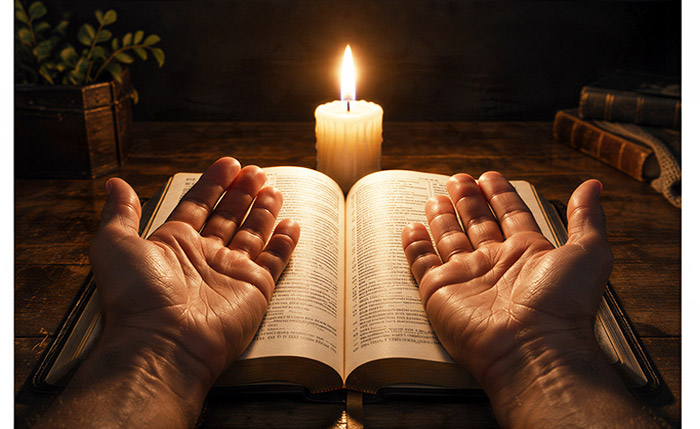
Top image credit: Outstretched hands in prayer before an open Bible and candle, from Bigstock.com, © by Kalina Vova, stock photo ID: 19540097, used with permission. Additional AI enhancement from Artstyles,com, used with permission.