


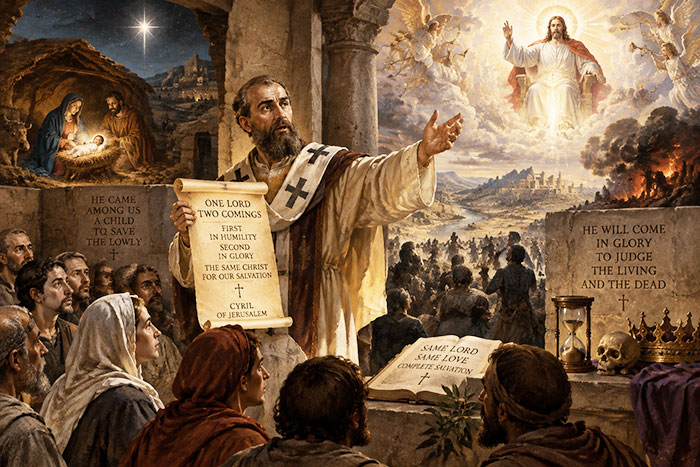
Note: This Advent reading on the two comings of Christ is an excerpt from Cyril of Jerusalem’s catechetical instruction of adults preparing for baptism around AD 360. Cyril contrasts Christ’s first coming in humility with Jesus’ second coming in glory.
We do not preach only one coming of Christ, but a second as well, much more glorious than the first. The first coming was marked by patience; the second will bring the crown of a divine kingdom.
In general, whatever relates to our Lord Jesus Christ has two aspects. There is a birth from God before the ages, and a birth from a virgin at the fullness of time. There is a hidden coming, like that of rain on fleece, and a coming before all eyes, still in the future.
First & second coming
At the first coming he was wrapped in swaddling clothes in a manger. At his second coming he will be clothed in light as in a garment. In the first coming he endured the cross, despising the shame; in the second coming he will be in glory, escorted by an army of angels.
We look then beyond the first coming and await the second. At the first coming we said: Blessed is he who comes in the name of the Lord. At the second we shall say it again; we shall go out with the angels to meet the Lord and cry out in adoration: Blessed is he who comes in the name of the Lord.
He will come to judge
The Savior will not come to be judged again, but to judge those by whom he was judged. At his own judgement he was silent; then he will address those who committed the outrages against him when they crucified him and will remind them: You did these things, and I was silent.
His first coming was to fulfill his plan of love, to teach men by gentle persuasion. This time, whether men like it or not, they will be subjects of his kingdom by necessity.
The prophet Malachi speaks of the two comings.
“Behold, I send my messenger to prepare the way before me, and the Lord whom you seek will suddenly come to his temple; the messenger of the covenant in whom you delight, behold, he is coming, says the Lord of hosts. But who can endure the day of his coming, and who can stand when he appears? “For he is like a refiner’s fire and like fullers’ soap; he will sit as a refiner and purifier of silver, and he will purify the sons of Levi and refine them like gold and silver, till they present right offerings to the Lord.
Malachi 3:1-3
These two comings are also referred to by Paul in writing to Titus:
“For the grace of God has appeared for the salvation of all men, training us to renounce irreligion and worldly passions, and to live sober, upright, and godly lives in this world, awaiting our blessed hope, the appearing of the glory of our great God and Savior Jesus Christ.”
Titus 2:11-13
Notice how he speaks of a first coming for which he gives thanks, and a second, the one we still await.
His Kingdom will have no end
That is why the faith we profess has been handed on to you in these words: He ascended into heaven, and is seated at the right hand of the Father, and he will come again in glory to judge the living and the dead, and his kingdom will have no end.
Our Lord Jesus Christ will therefore come from heaven. He will come at the end of the world, in glory, at the last day. For there will be an end to this world, and the created world will be made new.
This Advent reading is an excerpt from his catechetical instruction of adults getting ready for baptism (Cat. 15, 1-3: PG 33, 870-874), English translation source: The Office of Readings.
Top image credit: An Illustration of Bishop Cyril of Jerusalem explaining to his congregation the two-fold coming of Christ. Image created with digital paintbrush and AI enhanced artwork from © Artstyles.com. Used with permission.