


Intro: The beatitudes of the Old Testament Scriptures find their fulfilment in the Lord Jesus Christ who comes to bring his disciples into the fullness of God’s kingdom reign in their personal and corporate lives as members of his body on earth – the Church which he established through his death, resurrection, and ascension into heaven.
The beatitude of meekness is a direct quote from Psalm 37.
1 Do not fret because of the wicked, be not envious of wrongdoers! 2 For they will soon fade like the grass, and wither like the green herb. 3 Trust in the Lord, and do good; so you will dwell in the land, and be nourished in safety. 8 Refrain from anger, and forsake wrath! Do not fret; it tends only to evil. 9 For the wicked shall be cut off; but those who wait for the Lord shall possess the land.
11 But the meek shall possess the land, and delight themselves in abundant prosperity. 16 Better is a little that the righteous has than the abundance of many wicked. 21 The wicked borrows, and cannot pay back, but the righteous is generous and gives; 22 for those blessed by the Lord shall possess the land, but those cursed by him shall be cut off. 29 The righteous shall possess the land, and dwell upon it for ever. 34 Wait for the Lord, and keep to his way, and he will exalt you to possess the land; you will look on the destruction of the wicked.
What is the beatitude of meekness?
In our modern culture meekness is often viewed negatively as being a weak, spineless, subservient and ineffective person. In biblical times it described a very positive quality. The Hebrew word for meek, anaw, is translated interchangeably as humble, lowly, and meek. It is used throughout the Psalms to describe our attitude towards God. God opposes the proud but gives grace to the humble (Proverbs 3:34, James 45-6) and looks favourably on those who humbly love and obey Him.
The Greek word for meekness (praotes) carries a multi-layered usage. Aristotle saw meekness as the virtue that lies between opposing extremes of cold cruelty and burning wrath. The meek person is neither too hasty nor too slow-tempered. The meek person bears reproaches and slights, and is not bent on revenge, free from bitterness, and possesses tranquillity and steadiness of spirit” (Jim Forest, The Ladder of the Beatitudes).
The Greek word for meek (praus) was also used to describe a wild animal that had been tamed and made gentle, and trained to obey a command – like a tamed horse that a rider could use and direct, or a dog trained to tend sheep and keep them from straying from the fold. In the human sphere, the virtue of meekness is marked by self-control and the discipline to be gentle rather than severe or violent.
Scripture instructs us in taming our tongue and quieting our spirit. “He who is slow to anger is better than the mighty, and he who rules his spirit than he who takes a city” – Proverbs 16:32.
Saint Augustine of Hippo on the beatitude of meekness and its reward:
Blessed are the meek, for they shall inherit possession of the earth (Matthew 5:5). You want possession of the earth now; make sure that you don’t find yourself possessed by the earth. You will possess it if you are meek, you will be possessed by it if you are rough. And take care too, when you hear the prize offered, possession of the earth, that you don’t stretch out the skirts of your greed (Mathew 5:4), which wants to possess the earth now and keep your neighbor out by fair means or foul; don’t fall for this idea. You will only in very truth possess the earth when you stick closely to the one who made heaven and earth. That’s what being meek means, you see, not resisting your God; insofar as you do good, taking pleasure in him, not being pleased with yourself; insofar as you justly suffer evil, being displeased with yourself and not with him. It’s no small thing, after all, to please him by being displeased with yourself; you will certainly displease him by being pleased with yourself. (Sermon 53)
I believe that the earth referred to here is the one spoken of in the Psalms: You are my hope, my heritage in the land of the living (Psalm 142:5). It indicates that the eternal inheritance has a kind of solidity and stability where the soul, possessed of true affection, rests in its own place as a body does on the earth, and is nourished there on its own food just as a body is from the earth. Such is the repose and life of the saints. The meek are those who yield to insults and do not resist evil but conquer evil with good. Let the violent dispute and fight over what is earthly and temporal, but blessed are the meek, for they shall inherit the earth, from which they cannot be driven out.
How do we grow in meekness? Jesus said, “Take my yoke upon you, and learn from me; for I am gentle and lowly in heart, and you will find rest for your souls. For my yoke is easy, and my burden is light” (Matthew 11:29-30). The humble place all their trust and dependence on God who by the Holy Spirit works in and through us for his good pleasure.
Example of Moses: Moses is described as “very meek, above all the men which were upon the face of the earth” (Numbers 12:3). Moses was not born meek; in his youth, he had a hot temper and killed an Egyptian taskmaster out of impulsive anger. His 40 years as a humble shepherd in the wilderness of Midian stripped away his pride and taught him complete reliance on God.
Moses’ own siblings, Miriam and Aaron, criticized him for his leadership and his Cushite wife. Instead of defending himself or lashing out for his own honor, Moses stayed silent and let God fight his battle. After God disciplined Miriam with leprosy for rebelling against Moses, Moses did not gloat or harbor bitterness. Instead, he immediately prayed to God on her behalf, pleading for her healing. (Numbers 12)
For 40 years, Moses led over a million complaining, ungrateful Israelites through the harsh wilderness, enduring constant murmurings and even threats of stoning, yet he continued to intercede for them before God. He was patient with a rebellious people. He was zealous for God, mild for himself: As commentators note, Moses could be as “bold as a lion” when defending God’s holiness or the people, such as when dealing with Pharaoh or confronting idolatry, yet he was as “mild as a lamb” when his own ego or reputation was personally insulted.
Example of the Blessed Virgin Mary who was meek and humble of heart, and who willingly shared in her Son’s sufferings and death on the cross: “For with God nothing will be impossible. And Mary said, ‘Behold, I am the handmaid of the Lord; let it be to me according to your word.’” – Luke 1:37-38
“46 My soul magnifies the Lord,47 and my spirit rejoices in God my Savior, 48 for he has regarded the low estate of his handmaiden. For behold, henceforth all generations will call me blessed; 49 for he who is mighty has done great things for me, and holy is his name. 50 And his mercy is on those who fear him from generation to generation. 51 He has shown strength with his arm, he has scattered the proud in the imagination of their hearts, 52 he has put down the mighty from their thrones, and exalted those of low degree; 53 he has filled the hungry with good things, and the rich he has sent empty away.”
Luke 1:46-53
Questions for reflection:
- How does the Blessed Virgin Mary, Joseph her spouse, and other Christ-centered witnesses show us the way of meekness, faith, trust, and obedience?
- Where do I need the Lord’s grace and help to “seek first the kingdom of God” (Matthew 6:33)?
See related articles in Living Bulwark:
- On the Beatitudes of God’s Kingdom, by Augustine of Hippo
- The Beatitudes Are Inseparable from the Cross, by Fulton J. Sheen
- Living the Beatitudes as Christ Has Taught Us, by Steve Clark
- Jesus Calls his Community of Disciples “Blessed”, by Dietrich Bonhoeffer
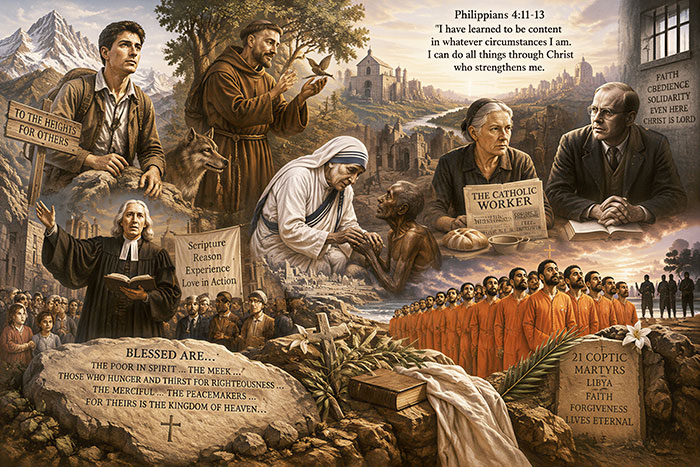
Top image credit: Composite illustration of Christian witnesses throughout the ages who show us the way of Christ’s beatitudes, Pier Giorgio Frassatti, John Wesley, Saint Francis of Assisi, Mother Theresa, Dorothy Day, Dietrich Bonhoeffer, and the 21 Coptic Martys of Libya. Image created with digital paintbrush and AI enhanced artwork from © Artstyles.com. Used with permission.